Priority 1 Air Rescue Marks Eight Years Training U.S. Coast Guard Flight Mechanics
P1AR's USCG "C" School has become a core pipeline for mission-ready hoist operators flying MH-60 and MH-65
Press Release Disclaimer: This is a press release distributed through the XPR Media network. It has not been independently verified by our newsroom.
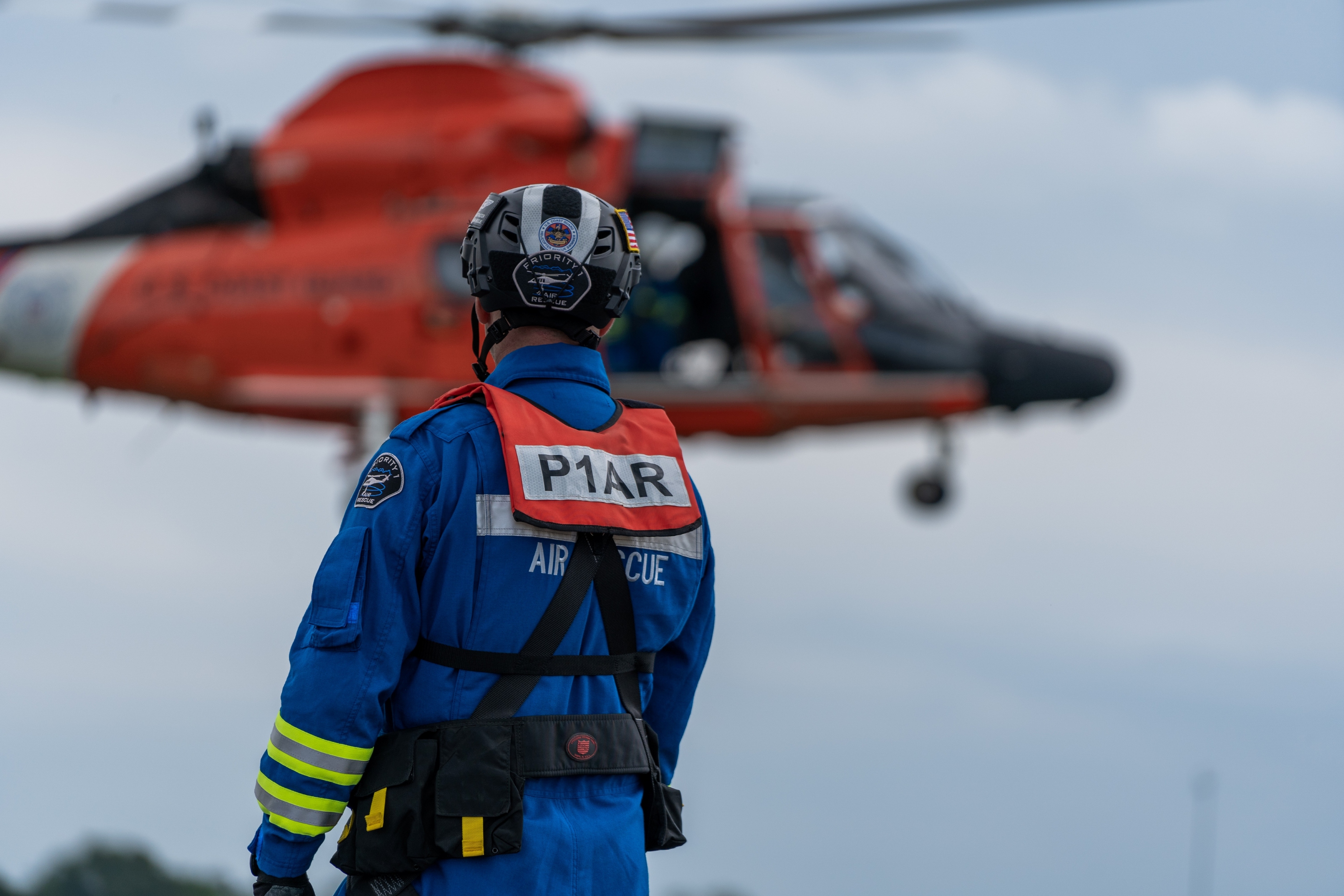

P1AR’s USCG “C” School has become a core pipeline for mission-ready hoist operators flying MH-60 and MH-65 search-and-rescue missions nationwide
MESA, AZ, UNITED STATES, September 28, 2026 /EINPresswire.com/ — Priority 1 Air Rescue (P1AR) this month marked the eighth year of its training partnership with the U.S. Coast Guard, having now trained more than 550 Flight Mechanics through its USCG “C” School — the service’s hoist operator qualification pipeline for the MH-60 and MH-65 helicopter fleets. Since the program began in 2018, students have completed over 130,000 individual hoist evolutions and nearly 6,000 hours of synthetic simulation training. These training evolutions prepare students to execute rescues across a broad mission profile: inland, vessel, offshore rescue swimmer, and day/night rescue scenarios.
Flight Mechanics attend the 12-day course at P1AR’s Mesa, Arizona facility, combining ground school instruction, hoist procedural tower training, and synthetic simulation on P1AR’s Advanced Aircrew Mission Simulator before returning to their units to operate rescue equipment during live search-and-rescue missions. On average, each graduate completes more than 225 hoist iterations during the course — key sets and reps that build the muscle memory needed to execute real-world rescues safely and effectively.
“We want to make them mission ready, so when they go out there, they’re able to jump in the helicopter and go save a life,” said Ian Gaertner, manager of P1AR’s Mesa Search and Rescue Tactical Training Academy.
The Flight Mechanics — the non-pilot crew members who operate the aircraft’s rescue hoist — are a key part of the Coast Guard’s search and rescue (SAR) mission set, working alongside pilots and rescue swimmers to recover survivors from vessels, open water, and flooded or otherwise inaccessible terrain. P1AR was selected for the program in 2018 after a competitive process, and its curriculum has since become a standardized training reference the Coast Guard has extended and renewed.
About Priority 1 Air Rescue
Priority 1 Air Rescue (P1AR) trains helicopter rear crew around the world to operate SAR and tactical systems. Founded in 1999, P1AR has trained more than 15,000 aircrew across 40+ countries with zero accidents since inception, delivering instruction across a continuum of classroom, hoist procedural tower, virtual simulation, and live-flight training. P1AR’s Advanced Aircrew Mission Simulator (AAMS) allows crews to conduct everything from basic emergency procedures and crew coordination to full-mission rehearsals that integrate multiple aircraft, changing threats, aerial gunnery, personnel recovery, combat search and rescue (CSAR) hoist operations, and geographically accurate mission environments. In addition to its work with the U.S. Coast Guard, P1AR provides training for the U.S. Air Force, U.S. Customs and Border Protection, and dozens of law enforcement and SAR agencies around the world. P1AR operates training centers in Mesa, Arizona, and in Bordeaux, France.
David Eng
Priority 1 Air Rescue
+1 480-621-6023
email us here
Legal Disclaimer:
EIN Presswire provides this news content “as is” without warranty of any kind. We do not accept any responsibility or liability
for the accuracy, content, images, videos, licenses, completeness, legality, or reliability of the information contained in this
article. If you have any complaints or copyright issues related to this article, kindly contact the author above.

Media gallery