Secondhand Isn’t About Settling: 81% of U.S. Shoppers Say Resale Puts What They Really Want Within Reach, According to OfferUp’s 2026 Recommerce Report
SEATTLE, Oct. 22, 2026
Press Release Disclaimer: This is a press release distributed through the XPR Media network. It has not been independently verified by our newsroom.

Secondhand Isn’t About Settling: 81% of U.S. Shoppers Say Resale Puts What They Really Want Within Reach, According to OfferUp’s 2026 Recommerce Report
PR Newswire
SEATTLE, Oct. 22, 2026
Read the full report at www.RecommerceReport.com
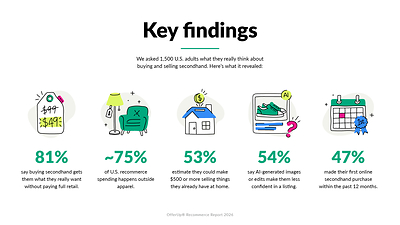
- Secondhand puts what shoppers really want within reach: 81% of U.S. shoppers say buying secondhand gets them what they want without paying full retail price – especially with 51% saying tariff-related price concerns make them more likely to shop secondhand.
- Americans have resale value hiding at home: 95% of U.S. shoppers own at least one type of item they think they could sell or resell, and it’s not just clothes: roughly 75% of U.S. recommerce spending happens outside apparel.
- Gen Z doesn’t want to lose privacy or authenticity: 47% have avoided listing an item because they didn’t want friends, relatives or coworkers to see it, and 68% say AI-generated or substantially edited images make them less confident in a listing.
SEATTLE, Oct. 22, 2026 /PRNewswire/ — Today, OfferUp, the mobile marketplace that helps millions buy, sell, and connect locally, released its 2026 Recommerce Report, available now at www.RecommerceReport.com. The eighth annual report, published in partnership with retail analytics firm GlobalData, reveals that secondhand is becoming a bigger part of how Americans shop, helping consumers get more of what they want for their money while unlocking value from things they already own. The report also shows how resale is evolving alongside the broader retail landscape. Economic pressures, including rising costs and tariff concerns, are making the financial flexibility of recommerce increasingly relevant, while new technology is introducing conveniences – and new questions about trust, authenticity and control.
Secondhand is already part of how Americans shop
Secondhand remains firmly embedded in everyday shopping, with 90% of U.S. shoppers reporting buying something secondhand in the past year and 51% selling something. Existing shoppers aren’t slowing down, either: 81% are spending as much or more time on online resale platforms than they were a year ago, while 78% are buying as many or more secondhand items.
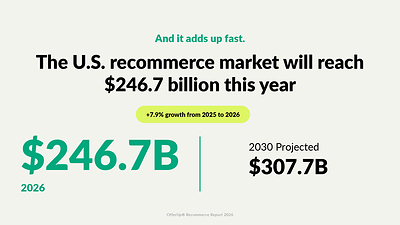
That activity is helping recommerce claim a larger role in the U.S. retail economy. The total U.S. recommerce market is expected to reach $246.7 billion in 2026, up 7.9% from 2025, and grow to $307.7 billion by 2030. Recommerce is also projected to account for 8.3% of U.S. retail spending by the end of the decade.
Just as importantly, secondhand is becoming part of a broader range of everyday purchase decisions. Eighty-one percent of U.S. shoppers say buying secondhand allows them to get what they really want without paying full retail price, and more than half (51%) choose secondhand always or most of the time when a suitable option is available. Among Gen Z, that rises to 67%, with 41% saying they buy secondhand to access higher-quality or higher-end products they otherwise couldn’t afford.
That mindset extends well beyond clothing. Roughly three-quarters of U.S. recommerce spending happens outside apparel, across categories including furniture, electronics, home improvement, sporting goods and auto. Secondhand is also entering the consideration set for bigger purchases: before buying a physical item costing $100 or more, 44% of U.S. shoppers check whether they can find it secondhand first.
Secondhand is giving Americans more financial flexibility
The value of recommerce works in both directions: shoppers can make their budgets go further when they buy, while sellers can unlock value from things they already own. Nearly all U.S. shoppers (95%) own at least one type of item they believe they could sell or resell. Among those with something to sell, 53% estimate they could make at least $500 from items they already own, one-third (33%) believe they could make $1,000 or more, and 13% estimate they could make $3,000 or more.
For those earning money through resale, those proceeds are flowing back into everyday life. More than half (51%) use the money they earn to pay bills or everyday expenses, 41% put it toward savings and 25% use it to pay down debt. Resale is also helping fund what’s next: 11% use their earnings to start or grow a business or side hustle, rising to 18% among Gen Z sellers.
That financial flexibility is especially relevant as households navigate continued economic pressure. Seven in ten U.S. shoppers (71%) say economic or financial concerns influenced their decision to buy or sell secondhand over the past year, with 56% specifically pointing to cost of living or inflation. Among Gen Z, 91% say economic or financial concerns have influenced their resale behavior.
Tariff-related price concerns are also making secondhand more appealing. More than half (51%) of U.S. shoppers say concerns about tariff-related price increases have made them more likely to consider purchasing certain items secondhand rather than new, rising to 66% among Gen Z.
As resale gets more digital, shoppers still want trust and control
Technology is making it easier to buy and sell secondhand, but shoppers are drawing clear lines around how they want it to shape the experience. Consumers see useful roles for AI in reducing friction, including suggesting prices (39%), identifying an item or category (30%) and drafting listing titles or descriptions (29%). When AI changes what shoppers actually see, however, confidence declines: 54% say AI-generated images or substantial edits that change how an item appears make them less confident in a listing, rising to 68% among Gen Z.
Younger shoppers are also signaling that buying and selling doesn’t need to become another extension of their social lives. Nearly half (47%) of Gen Z have avoided listing something because they didn’t want friends, relatives or coworkers to see what they were selling, compared with 30% of U.S. shoppers overall. More than half (55%) prefer a dedicated resale marketplace with a profile used only for buying and selling.
Even as resale becomes increasingly digital, shoppers continue to value the confidence and control that can come from keeping transactions local. When given the choice, 38% of U.S. shoppers prefer buying from someone nearby and picking the item up locally, compared with 25% who prefer having it shipped. That preference may also reflect the uncertainty shoppers can encounter when buying something sight unseen: among secondhand shoppers who have had an item shipped, 41% have received something that turned out to be different from how it was described.
Together, the findings show a resale economy that is becoming more integrated into everyday shopping without losing the qualities consumers value most. Shoppers are increasingly turning to secondhand to get more for their money and unlock value from what they already own, while looking for technology that makes the experience easier without sacrificing authenticity, privacy or control.
View the complete 2026 OfferUp Recommerce Report here. For the full press kit, including hi-res images of the report, charts and illustrations, click here.
Browse our online marketplace at https://offerup.com/. For more information on OfferUp, please visit our company page here.
Methodology
The OfferUp Recommerce Report includes research and data from retail analytics firm GlobalData. GlobalData uses consumer surveys, retailer tracking, official data, data sharing, store observation, and secondary sources to analyze, model, and calculate metrics, including market and channel size, and market share. Online market research provider Pollfish conducted an August 2026 survey of 1,500 U.S. adults, asking specific questions about their recommerce buying and selling behaviors.
About OfferUp
OfferUp is unleashing the power of local. From great deals on secondhand finds to pro services, home rentals, jobs, and more, our mobile marketplace helps people discover more of what they need, right where they are. Built with simplicity and safety at the core, our trusted platform empowers millions to buy, sell, and connect in their communities. The OfferUp app is available on iOS and Android and has consistently ranked among the top shopping apps. Founded in 2011 and based in Bellevue, WA, OfferUp serves local markets nationwide and was used by more than 1 in 6 adults in the U.S. in 2025. OfferUp is backed by leading investors, including Andreessen Horowitz, Warburg Pincus, GGV Capital, T. Rowe Price, and Coatue Management. Learn more: https://about.offerup.com.
 View original content to download multimedia:https://www.prnewswire.com/news-releases/secondhand-isnt-about-settling-81-of-us-shoppers-say-resale-puts-what-they-really-want-within-reach-according-to-offerups-2026-recommerce-report-302916051.html
SOURCE OfferUp