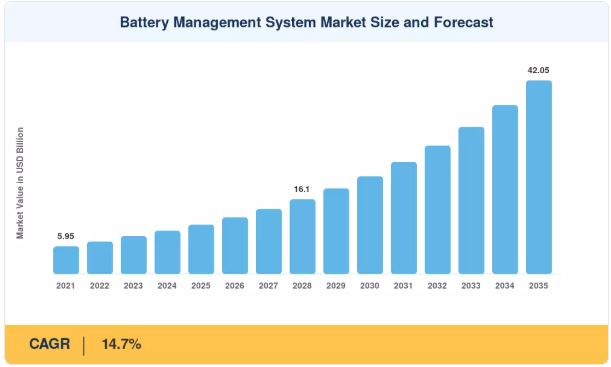
Battery Management System Market Valued at USD 10.58 Billion in 2025 to Reach USD 42.05 Billion at 14.7% CAGR in 2035
Battery Management System Market Size, Share and Research Report By Battery Type (Lithium-Ion Based Batteries, Advanced
Press Release Disclaimer: This is a press release distributed through the XPR Media network. It has not been independently verified by our newsroom.

Battery Management System Market Size, Share and Research Report By Battery Type (Lithium-Ion Based Batteries, Advanced Lead-Acid Batteries)
NEW YORK,, NY, UNITED STATES, August 31, 2026 /EINPresswire.com/ — The Battery Management System Market is becoming increasingly important as electric mobility, renewable energy storage, and portable electronics expand worldwide. The Battery Management System Market is benefiting from the need to monitor, protect, balance, and optimize rechargeable batteries across automotive, industrial, consumer, and energy-storage applications.
➤ Market Overview:
The Battery Management System Market stood at approximately USD 10.58 billion in 2025 and is projected to reach USD 12.24 billion in 2026, before climbing to USD 42.05 billion by 2035. The industry is expected to advance at a strong 14.7% CAGR during 2026–2035, supported by accelerating battery adoption across multiple sectors.
Asia-Pacific commands roughly 56% of the market, supported by China’s vertically integrated cell-to-pack ecosystem and extensive battery manufacturing capabilities. The region is also expected to record the fastest expansion at an estimated 17.6% CAGR through 2035, while North America and Europe benefit from policy support and evolving battery regulations.
➤ Rising Importance of Battery Management Systems:
Battery Management Systems, commonly known as BMS, are essential for maintaining battery safety, performance, and longevity. These systems continuously monitor parameters such as voltage, current, temperature, and state of charge across individual cells and battery packs.
As battery-powered products become more powerful and complex, precise battery monitoring is becoming increasingly necessary. BMS technology helps prevent overcharging, deep discharge, overheating, and cell imbalance, supporting reliable operation across a wide range of applications.
Get Full PDF Sample Copy of Report: (Including Full TOC, List of Tables & Figures, Chart) @
https://www.marketresearchfuture.com/sample_request/8577
➤ Electric Vehicles Accelerate Adoption:
The rapid expansion of electric vehicles is one of the strongest growth drivers for the Battery Management System Market. Electric cars, buses, commercial vehicles, and two-wheelers depend on sophisticated battery packs that require continuous monitoring and control.
Automotive BMS platforms help manage battery temperature, charge levels, energy distribution, and cell balancing. As automakers introduce longer-range vehicles and larger battery packs, demand is increasing for advanced systems capable of improving efficiency while maintaining safety and battery durability.
➤ Growth of Energy Storage Systems:
Grid-scale and distributed energy storage are creating another major opportunity for BMS providers. Renewable power generation from solar and wind is increasing the need for energy storage technologies that can balance fluctuations in electricity supply. Battery management systems help energy-storage operators monitor large battery arrays and optimize charging and discharging cycles. Their role becomes particularly important in utility-scale storage installations, commercial energy systems, and residential battery platforms where long operating life and safety are critical.
➤ Renewable Energy Supports Market Expansion:
The transition toward renewable energy is closely connected to battery technology development. Solar-plus-storage and wind-plus-storage projects require reliable battery packs capable of storing electricity and delivering it when demand increases or renewable generation declines. Advanced BMS solutions can improve the performance of these systems by maintaining balanced cell conditions and identifying abnormal operating patterns. As countries continue expanding clean-energy capacity, the demand for intelligent battery monitoring technologies is expected to rise.
➤ Demand for Battery Safety:
Safety remains a central consideration in rechargeable battery deployment. Lithium-ion batteries can experience thermal runaway and other failure conditions when damaged, improperly managed, or exposed to unsuitable charging and temperature conditions.
BMS technologies provide multiple layers of protection by detecting abnormal voltage, current, and temperature conditions. Advanced monitoring can trigger protective responses before small abnormalities develop into larger battery failures, making safety functionality a crucial purchasing consideration.
➤ Cell Balancing Technology:
Cell balancing is another essential BMS function. Battery packs contain multiple cells, and differences in their capacities or electrical characteristics can gradually affect overall pack performance. Balancing technologies help distribute charge more evenly across cells, improving usable battery capacity and reducing stress on individual components. More sophisticated balancing architectures can support higher-performance battery packs while helping extend operational life.
➤ Artificial Intelligence and Intelligent BMS:
Artificial intelligence and machine learning are gradually transforming conventional battery management into more predictive and intelligent systems. Data collected from battery cells can be analyzed to identify patterns associated with degradation, abnormal behavior, and performance changes.
Intelligent BMS platforms can potentially estimate battery health more accurately and support predictive maintenance. These capabilities are increasingly valuable for electric vehicles, energy-storage facilities, and industrial batteries where unexpected failures can result in high replacement or operational costs.
Get access to the full description of the report @
https://www.marketresearchfuture.com/reports/battery-management-system-market-8577
➤ Who Are the Key Players in the Battery Management System Market?
The battery management system market exhibits medium concentration, with the top five players commanding an estimated 38-45% combined revenue share. The competitive field spans semiconductor specialists, integrated cell manufacturers, and pure-play BMS software firms. Strategic acquisitions, such as large chipmakers adding cybersecurity and Ethernet IP, continue to blur traditional competitive boundaries. MRFR identifies the following key participants:
• Texas Instruments (~8–11% share)
• Analog Devices (~7–10% share)
• NXP Semiconductors (~5–8% share)
• Renesas Electronics (~4–7% share)
• STMicroelectronics (~4–6% share)
• Infineon Technologies (~4–6% share)
• BYD Company (~3–5% share)
• Contemporary Amperex / CATL (~3–5% share)
• LG Energy Solution (~2–4% share)
• Samsung SDI (~2–4% share)
Strategic competition in the battery management system market is increasingly defined by cloud-connected platform economics and cybersecurity integration with raw-material cost volatility cited as a top structural headwind, as spot prices for lithium carbonate fluctuated from USD 75,000 per tonne in late 2022 to less than USD 15,000 per tonne by mid-2024 before rising again, delaying OEM design-freeze decisions and reducing order visibility windows for BMS providers from 18 months to as little as 6 months, alongside semiconductor supply-chain fragility concentrated in a few high-voltage analog front-end fabrication facilities, fragmented safety certification standards, cybersecurity risk in connected BMS platforms, and skilled-workforce shortages in power electronics.
➤ What Are the Emerging Trends in the Battery Management System Market?
Several transformational trends are redefining the battery management system market’s evolution through 2035:
Cloud-Connected Fleet Analytics and Data Monetization: Fleet operators managing thousands of EV buses and delivery vans generate terabytes of cell-level telemetry daily, and BMS vendors offering cloud dashboards with predictive maintenance alerts can capture recurring SaaS revenue estimated at 15-20% of initial hardware value per year, shifting the market toward platform economics.
Second-Life Battery Grading and Certification: Retired EV packs retain 70-80% of original capacity and are increasingly repurposed for stationary storage, with accurate state-of-health data from the original management system serving as the key enabler for grading and warranty pricing, opening certification-services revenue for vendors that embed lifecycle data logging.
Emerging-Market Electrification in South and Southeast Asia: India’s FAME III subsidy scheme and Indonesia’s nickel-to-battery industrial policy are catalyzing domestic pack assembly at scale, with these markets currently importing the majority of their BMS hardware, opening a localization opportunity for chipmakers willing to establish regional design centers.
Solid-State Battery Integration: Solid-state cells operate at different voltage profiles and thermal envelopes than conventional lithium-ion chemistry, requiring purpose-built management algorithms, with early entrants co-developing BMS architectures alongside cell manufacturers in Japan and South Korea positioned to lock in design-win positions before volume production scales.
Cybersecurity-as-a-Service for Connected Packs: As BMS platforms become network-connected, they expand the vehicle’s attack surface, and vendors offering integrated cybersecurity monitoring alongside cell management can differentiate in the market and capture higher per-unit margins.
Buy Full Research Report:
https://www.marketresearchfuture.com/checkout?currency=one_user-USD&report_id=8577
➤ How Is the Battery Management System Market Segmented?
The battery management system market report provides a comprehensive segmentation framework:
By Battery Type: Lithium-Ion Based Batteries (48.5% share, 2025), Advanced Lead-Acid Batteries (USD 0.95 billion, 2025), Nickel-Based Batteries (9.4% CAGR), Flow Batteries (USD 0.32 billion, 2025), Solid-State (44.2% CAGR)
By Component: Hardware (66.8% share, 2025), Software (22.5% CAGR)
By Topology: Centralized (USD 2.48 billion, 2025), Distributed (39.2% share, 2025), Modular (16.8% CAGR), Hybrid / Wireless (24.7% CAGR)
By Voltage Range: Low Voltage — ≤20V (USD 0.74 billion, 2025), Medium Voltage — 20–60V (13.2% CAGR), High Voltage — >60V (60.7% share, 2025)
By Application: Automotive (53.0% share, 2025), Military & Defense, Medical, Portable Device, Telecommunication, Renewable Energy Systems, Stationary Energy Storage (28.5% CAGR), Uninterrupted Power Supply, Consumer Electronics (USD 1.22 billion, 2025), Others (14.1% CAGR)
By Region: Asia-Pacific (56.2% share, 2025), North America (13.8% CAGR), Europe (USD 1.57 billion, 2025), South America (16.2% CAGR), Middle East & Africa (USD 0.44 billion, 2025)
➤ Competitive Landscape:
Competition in the Battery Management System Market centers on accuracy, reliability, safety, scalability, connectivity, and software intelligence. Vendors are developing solutions that combine sensing hardware, embedded electronics, communication interfaces, and advanced analytics.
Strategic partnerships between battery manufacturers, automakers, semiconductor companies, and software providers are becoming increasingly important. Companies that can provide integrated BMS platforms across automotive and energy-storage applications may gain competitive advantages.
➤ Key Challenges:
The market also faces several challenges, including complex battery architectures, cybersecurity risks, high development requirements, and compatibility issues between cells, packs, and management platforms. Different applications often require highly customized BMS designs.
Cost pressure is another consideration, especially in mass-market electric vehicles and consumer devices. Manufacturers must balance advanced functionality with affordability while maintaining stringent safety and reliability requirements.
➤ Future Outlook:
The future of battery management will increasingly combine hardware precision with software intelligence. Real-time sensing, predictive analytics, cloud connectivity, and AI-based diagnostics are expected to make BMS platforms more capable and adaptive.
As batteries become central to electric mobility, renewable energy storage, robotics, and industrial electrification, demand for advanced management solutions will continue to increase. Vendors that can connect accurate hardware monitoring with intelligent digital platforms are likely to benefit from the long-term growth of the industry.
➤➤➤ Industry Analysis Reports by Market Research Future:
Hi-Fi Speaker System Market
https://www.marketresearchfuture.com/reports/hi-fi-speaker-system-market-4598
Autonomous Mobile Manipulator Robots Market
https://www.marketresearchfuture.com/reports/autonomous-mobile-manipulator-robots-ammr-market-10809
Smart Cameras Market
https://www.marketresearchfuture.com/reports/smart-cameras-market-1326
Smart Indoor Lighting Market
https://www.marketresearchfuture.com/reports/smart-indoor-lighting-market-3780
Digital Process Automation Market
https://www.marketresearchfuture.com/reports/digital-process-automation-market-6651
Android Stb And Tv Market
https://www.marketresearchfuture.com/reports/android-stb-tv-market-10332
Europe Advanced Co2 Sensor Market
https://www.marketresearchfuture.com/reports/europe-advanced-co2-sensor-market-2574
Collision Avoidance Sensors Market
https://www.marketresearchfuture.com/reports/collision-avoidance-sensors-market-8167
Serdes Market
https://www.marketresearchfuture.com/reports/serdes-market-7428
Power Amplifier Market
https://www.marketresearchfuture.com/reports/power-amplifier-market-1705
Market Research Future
Market Research Future
+ +1 855-661-4441
email us here
Legal Disclaimer:
EIN Presswire provides this news content “as is” without warranty of any kind. We do not accept any responsibility or liability
for the accuracy, content, images, videos, licenses, completeness, legality, or reliability of the information contained in this
article. If you have any complaints or copyright issues related to this article, kindly contact the author above.

Media gallery