Seoul National University of Science and Technology Develops AI Framework to Test and Improve Vision-System Robustness
SEOUL, South Korea, Aug. 31, 2026
Press Release Disclaimer: This is a press release distributed through the XPR Media network. It has not been independently verified by our newsroom.

Seoul National University of Science and Technology Develops AI Framework to Test and Improve Vision-System Robustness
PR Newswire
SEOUL, South Korea, Aug. 31, 2026
AdvWT is a framework that uses realistic fading, cracks, and corrosion to test vulnerabilities in AI vision systems used in safety-critical applications
SEOUL, South Korea, Aug. 31, 2026 /PRNewswire/ — In computer vision and robotics, ensuring that AI systems remain reliable under real-world conditions is a growing challenge. Deep neural network (DNN)-based vision systems are increasingly used in safety-critical applications such as autonomous driving, where misinterpreting a traffic sign could potentially lead to unsafe decisions. Everyday wear and tear can subtly alter traffic signs, raising questions about whether naturally occurring damage could also expose vulnerabilities in AI-based recognition systems.
To understand and address the problem, a research team led by Associate Professor Seong Tae Kim from Kyung Hee University and Assistant Professor Hong Joo Lee from SEOULTECH developed Adversarial Wear and Tear (AdvWT)—a framework that exploits natural wear and tear as an adversarial signal. Their findings were made available online on February 3, 2026, and published in Volume 23, Issue 3 of IEEE Transactions on Dependable and Secure Computing on May 12, 2026.
“We focused on traffic signs because they are exposed to weather and environmental damage throughout their lifetime, and their accurate recognition is essential for safety-critical applications,” says Dr. Lee.
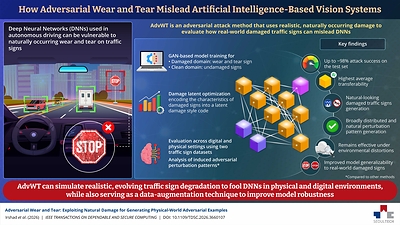
To create AdvWT, the team trained a generative image-to-image translation model to learn the visual characteristics of damaged and undamaged traffic signs. The model, based on StarGAN-v2, learned a latent “damage style” representation that can reproduce diverse forms of realistic deterioration while preserving the identity and meaning of the sign.
The framework was evaluated against two traffic-sign datasets and tested against eight recognition architectures. Across the evaluated models and datasets, AdvWT achieved near-perfect attack success rates on lightweight CNNs such as ResNet-18 and MobileNet, while also remaining effective against transformer-based models. AdvWT also achieved the highest average transferability across most tested model combinations, suggesting that the adversarial perturbations could transfer across different model architectures.
To test the framework in a physical setting, the researchers printed clean and adversarial speed-limit signs and photographed them under different distances, viewing angles, and indoor and outdoor conditions. The resulting images remained effective at misleading the traffic-sign classifier, showing that the adversarial effect persisted after printing and recapturing under varied physical conditions.
The researchers also demonstrated that the same bidirectional model could be used to restore naturally damaged traffic signs, suggesting potential applications beyond adversarial testing. Importantly, training models with AdvWT-generated damaged signs improved their ability to generalize to real-world damaged traffic signs, suggesting that simulated natural deterioration could be used to identify and strengthen weaknesses in vision systems.
“Building reliable AI requires more than improving average performance. It requires continuously identifying where AI systems fail, understanding why those failures occur, and using those insights to make the systems more robust. Over the next five to ten years, research in this direction could play an important role in developing AI systems that can be deployed more reliably in real-world, high-stakes domains such as healthcare and finance,” says Dr. Kim.
For autonomous driving, the findings highlight the need to evaluate how natural damage affects traffic-sign recognition and improve AI robustness to real-world deterioration.
Reference
Title of original paper: Adversarial Wear and Tear: Exploiting Natural Damage for Generating Physical-World Adversarial Examples
Journal: IEEE Transactions on Dependable and Secure Computing
DOI: https://doi.org/10.1109/TDSC.2026.3660107
About the institute Seoul National University of Science and Technology (SEOULTECH)
Website: https://en.seoultech.ac.kr/
Contact:
Seo-Hee Yoon
82-2-970-9166
421673@email4pr.com
 View original content to download multimedia:https://www.prnewswire.com/news-releases/seoul-national-university-of-science-and-technology-develops-ai-framework-to-test-and-improve-vision-system-robustness-302864974.html
SOURCE Seoul National University of Science and Technology

Media gallery